

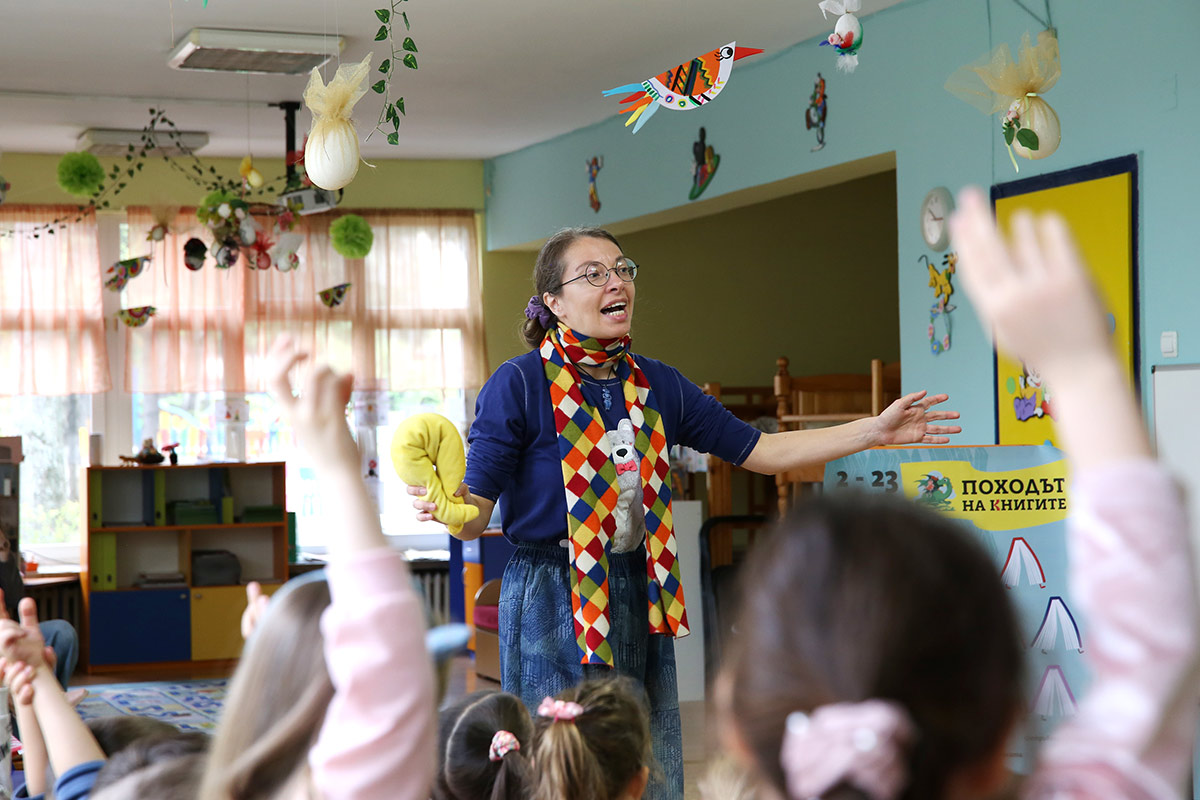
 Petia Kokudeva in a kindergarten in Sofia meeting kids. (Photo: Lora Topalova)
Interview with author Petia Kokudeva and translator Lora Nenkovska about the book "Lupo and Tumba", illustrated by Romina Beneventi
Petia Kokudeva is a highly acclaimed children's book author both in Bulgaria and in the countries where two of her most likeable characters reach the audience: they are Lupo and Tumba, a maypole, pointy-nosed dog and a tubby, giggling raccoon, two friends who look at the world with a keen eye for detail and engage in short, yet witty and humorous dialogues, offering a surprising perspective on ordinary situations.
Not only children, but also adult readers who enter the universe of Lupo and Tumba are enchanted by the whimsical exchanges and unexpected twists of perspective, not to mention the gorgeous illustrations by the Italian artist Romina Beneventi. The first part of the "Lupo and Tumba" series was awarded the prestigious Hristo G. Danov national award in 2018, in the "Children's Book" category. The volume has been translated into Croatian, Persian, German and Turkish.
The dialogues between Lupo and Tumba are brought into Romanian by the talented translator of Bulgarian origin Lora Nenkovska, and I took advantage of the recent publication of the book by Arthur Publishing House to ask Lora and Petia a few questions. Lora answered in Romanian and Petia in English, which is why there are two versions of the interview – the Romanian version is here.
You can meet Petia Kokudeva on Friday, June 5, from 12:00, at the Arena Stage of the Bookfest International Book Fair, hosted by Romexpo. Incidentally, Bulgaria is the guest of honor at this year's fair. The meeting entitled "Why do we need stories in the real world?", moderated by Domnica Drumea, will also be attended by the writer Florin Bican. The full schedule of Arthur’s events can be found on the blog and on Facebook.
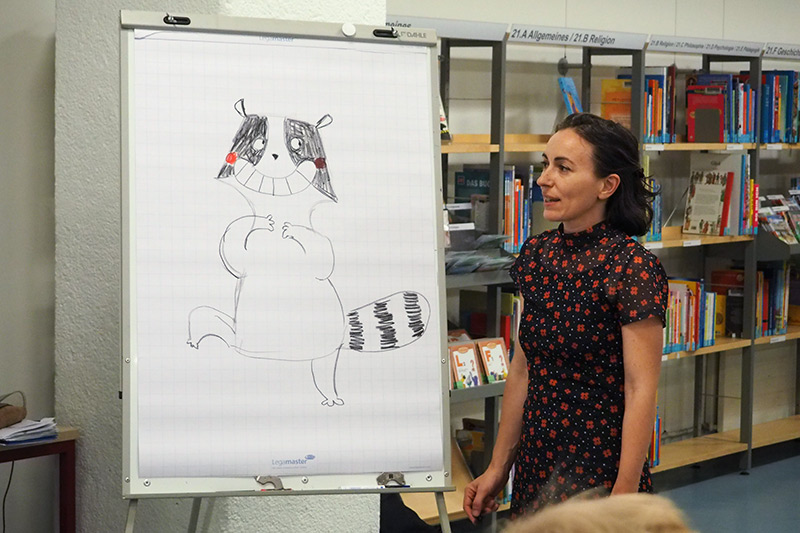
Illustrator Romina Beneventi in Germany presenting the German edition of the book
Petia Kokudeva, Lora Nenkovska, who are you? Tell us a little about yourselves, the readers want to get to know you. What amuses you, what saddens you, what excites you, what annoys you…things like that.
Petia: I get a real kick out of immersing myself in a foreign culture and having the locals tell me about their lives over breakfast (I have a particular soft spot for rugged places like Patagonia, the Sahara, Peru and Norway). My hobby is meeting strangers and striking up meaningful conversations. I’m a sucker for the forgotten art of face-to-face communication.
And what makes me sad? Over the past few years, I’ve spent a lot of time with refugee children from Yemen, Afghanistan, Syria, Iran, and Ukraine. One 11-year-old boy once told me he has no dreams – he just wants to live a calm, peaceful life.
I get annoyed with… myself most often. For the fact that I get discouraged and give up easily.
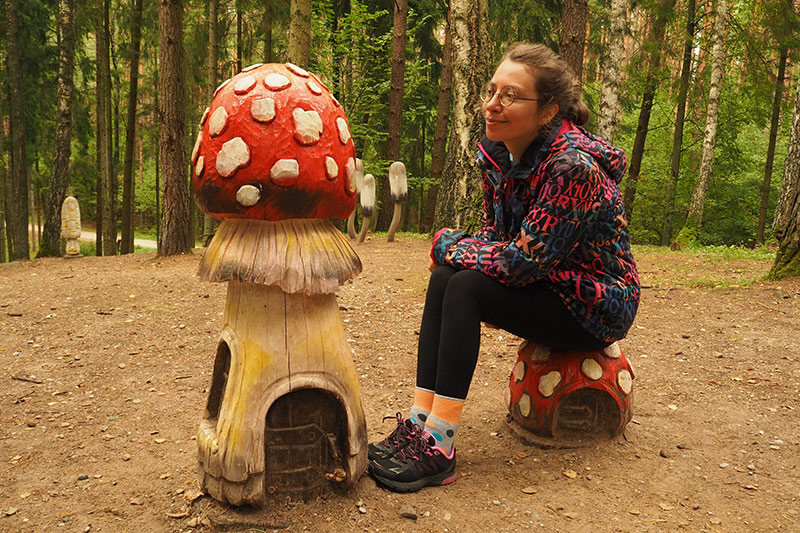 Petia Kokudeva traveling in Latvia's Enchanted Forest. (Photo: personal archive)
Lora: My name is Lora and I have very tousled hair. Even my younger boy calls me by the name of Ciufulici, a heroine of Petya Kokudeva. I wear glasses, which help me see the world around me better, and I adore reading and playing with words. I even chose a profession to match: I show students how to play with language, and in addition, I practice this game by translating books. I like to play sports and ride a bike. Among the most fun things for me are conversations with my two sons and the basketball games we play together. I am saddened by many things in the contemporary world, such as wars and climate change. I am easily touched by the beauty of the world – from the trees in the park near my house, to a remarkable painting, a dance or a play. Otherwise, I hardly get angry. I could say that my superpower is calmness, and this is a skill wonderfully trained through translation.
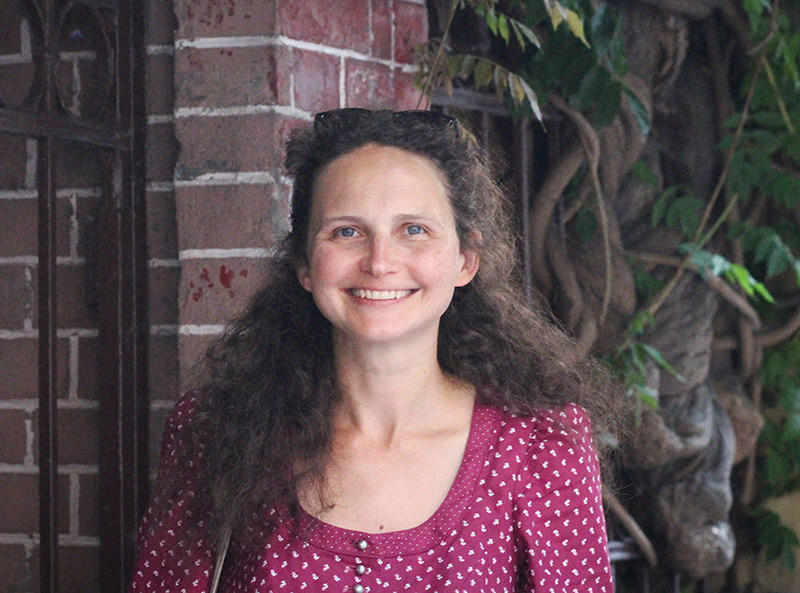
Lora Nenkovska: "I could say that my superpower is calmness,
and this is a skill wonderfully trained through translation."
Petia, what do you like about children's literature, both as a reader and as an author? What made you continue on this path and what are the challenges when writing for children?
Petia: In children’s literature and in my interactions with children I’m drawn to the same thing: lateral thinking. That surprising, unconventional, sometimes completely absurd kind of logic that makes you laugh and somehow saves the day. One example immediately comes to mind: in one of Mac Barnett’s books, a duck who ends up in a wolf’s belly says, “Just because we’ve been swallowed doesn’t mean we’ve been eaten!” That kind of sideways thinking runs through the work of all my favorite children’s authors: Tove Jansson, Shel Silverstein, Arnold Lobel, Carl Sandburg.
As for the challenges, the biggest one is psychological: the exhaustion that comes from this constant feeling that we are in a battle, that we must fight to keep reading alive in a world where most people don’t read books at all.
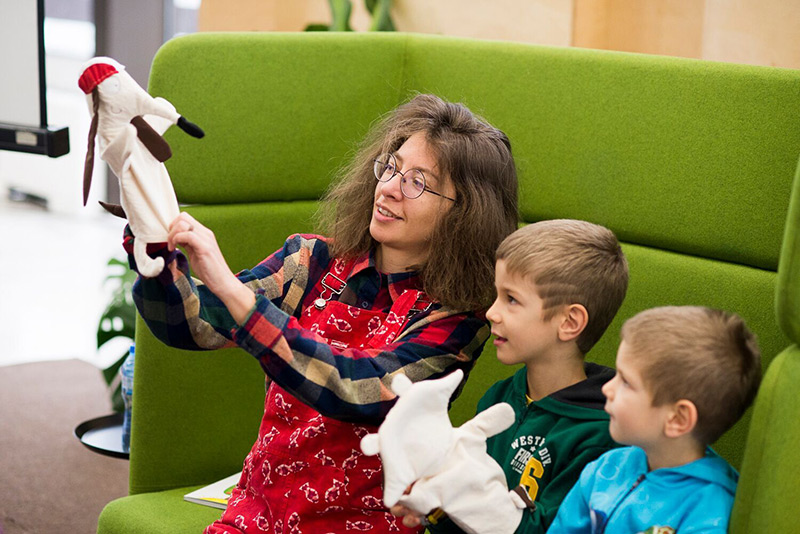
Petia Kokudeva with kids in Sofia playing with the puppets of Lupo and Tumba. (Photo: Yana Lozeva)
Lora, how do you view children’s literature from an adult perspective? Do you still read such books or their time has passed for you?
Lora: I don't know if I still have an adult's perspective, because in the last 14 years, since I became a mother, I have been reading a lot of children's literature, and recently books for teenagers. I firmly believe that reading is extremely important for children and I have never stopped reading to my sons. I also believe that reading aloud develops much more than a rich vocabulary in children, it builds an inner emotional comfort, providing a sense of peace, safety and spiritual fusion. Now I even read the young adult novels that my eldest son is passionate about, so that we can discuss them together.
Upon reflection, I think I’ve never cut ties with children's literature. I even took such a course at the University, and a very good friend of mine is a specialist in this very field. For me, this remains literature of the highest craftsmanship, one that perfectly combines geniality, cleverness, gentleness and the ability to explain the world. I don't like didactic books, but those that invite us to adventure.
Petia Kokudeva, how did the "Lupo and Tumba" series come about? It is so full of candor and so funny! And it seems like an ongoing conversation between two sensitive children, very attentive to details, who "say crazy things".
Petia: A small art shop in Sofia was selling a painting of a gorgeous yet very sad raccoon wearing a bow tie. I really wanted to have it, but I didn’t have that much money. One day, it turned out that my coworkers had pooled their money for my birthday and gave me the painting as a gift! And I started writing short snippets, as if I wanted to cheer up that raccoon, to make him smile. Little by little, I started using my mom as the prototype for the cheerful Tumba—she’s like a child and often cracks jokes like, “Butterflies don’t have smelly feet because they only step on flowers.”
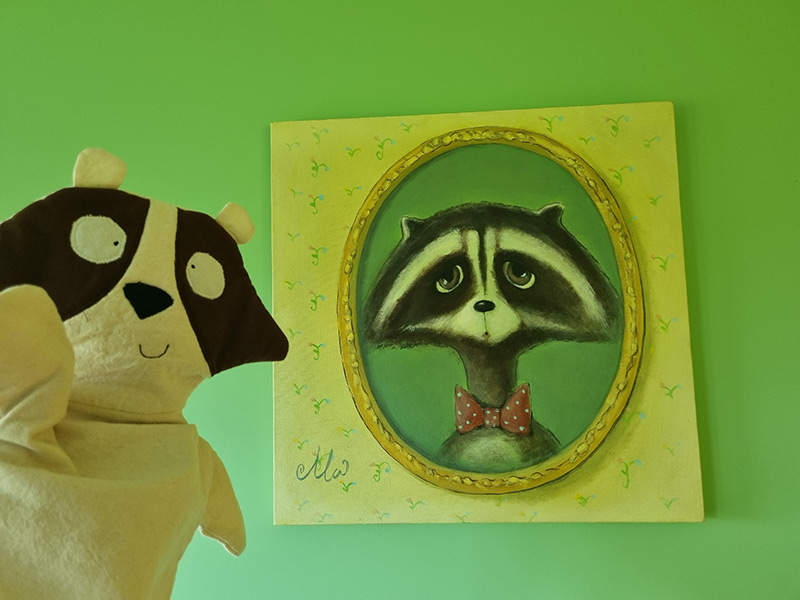
The sad raccoon painting (Photo: personal archive)
"I love words – you can play with them at any age", we learn from the bio at the end of the book. The book is truly a wonderful play on words, and reading it left me in a state of delight and optimism. Petia, do you have a favorite exchange between the dog Lupo and the raccoon Tumba?
Petia: My favorite episode is the one about the pillow because it’s based on my own life. I am a sleepyhead and I love pillows – they appear in some form in every one of my children’s books. My husband often says I love my pillow more than I love him.
Lora, I ask you, in case Petia is too modest to answer: how was the "Lupo and Tumba" series received in Bulgaria?
Lora: Petia Kokudeva is an extremely beloved author in Bulgaria. Her books are always awaited and received with great interest. The way Petia uses language is very special, and her care for illustrations and the way she works with artists give birth to a world in which you fully believe. Her trust in children and her eagerness to start a dialogue with them make her books exactly the literature I needed as a reader, as a mother, as a child who still lives inside me. And the publishing of the series "Lupo and Tumba" was rewarded with many smiles, laughter and precious time shared between parents and children.
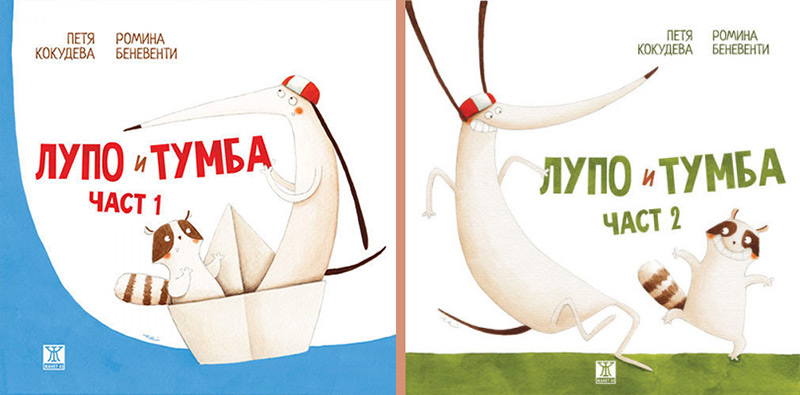
Bulgarian editions of the "Lupo and Tumba" series
Lora, how was the experience of translating this book? What challenges did you encounter?
Lora: For me, any translation is a challenge, and one from Bulgarian to Romanian is even greater. But I'll tell you a secret: when I like a text, my mind instantly starts working in translation mode. Usually, when I translate from Bulgarian to Romanian, I work on short texts that I can take with me to the park. That was the case with "Lupo and Tumba" – I took the printed pages with me and worked in the park in the summer. There were passages that flowed naturally and others that required me to rewrite the dialogues, to make them understandable to the Romanian audience. Not all idiomatic expressions in Bulgarian have an identical equivalent in Romanian, and I had to preserve without fail the tight connection between text and illustration. The truth is that I enjoyed myself immensely and I am extremely happy that I can share this wonderful book with more people.
On page 55 I noticed a neat wordplay, mai-muțări. I'm curious what is the original and how you resolved it in Romanian.
„— Pentru a câta oară te maimuțărești azi, Tumba?
— Păi, Lupișor, nu degeaba se zice mai-muțărești, fiindcă nu te muțărești doar o dată și gata, ci mai și mai...“
Lora: Haha! Yes, this is exactly one of the dialogues I had to invent in Romanian. In Bulgarian, the pun was based on the adverb "mai", so I needed an expression in Romanian that would contain "mai" and describe a not-so-good, slightly childish behavior. Then, the answer came naturally, because in Romanian there is the verb "a se maimuțări" ("to act the ape", "to put on an act").
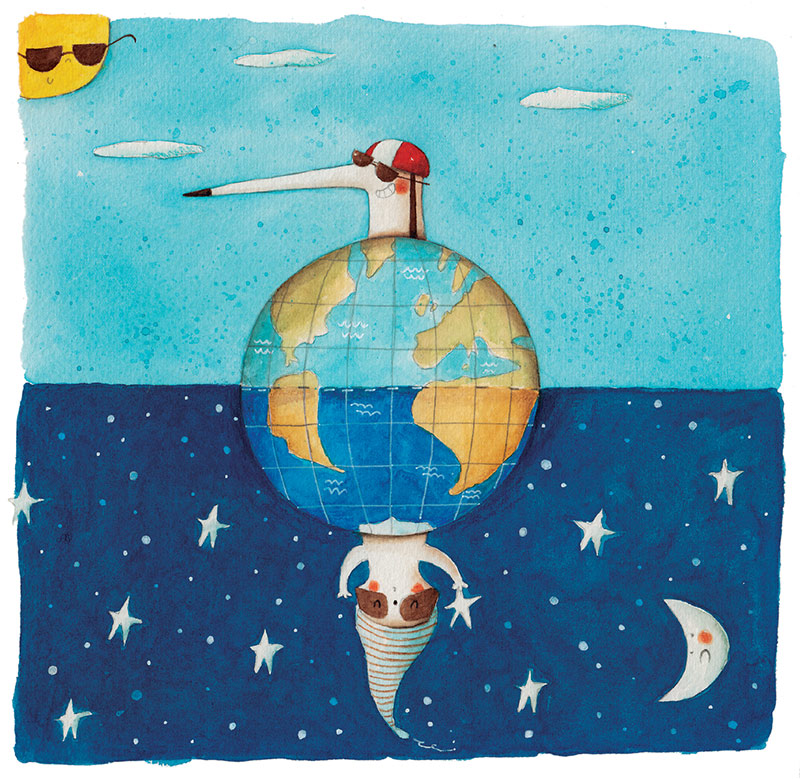
The illustrations by Romina Beneventi are absolutely gorgeous. Petia, how did you end up working with Romina and how did your collaboration go? Do you have a favorite illustration in this book?
Petia: It was a meeting brought about by fate. I was working on my master’s thesis in creative writing in Sofia University. It was a short book about a creature with no exact age – it could be young one moment and old the next. I stumbled upon Romina’s blog and wrote to her. She was enthusiastic about working together, and in fact, our first meeting was in Florence, when I went to visit her and brought her a physical copy of our debut book. After that, we made quite a few more books together, including Lupo and Tumba. For Tumba, she drew inspiration from her mischievous cat, Mini, and the visual prototype for Lupo is a wolf-chef who makes pizzas. My favorite illustrations are actually the pencil sketches; I love that edgy, unfinished and natural feel that the sketches have.
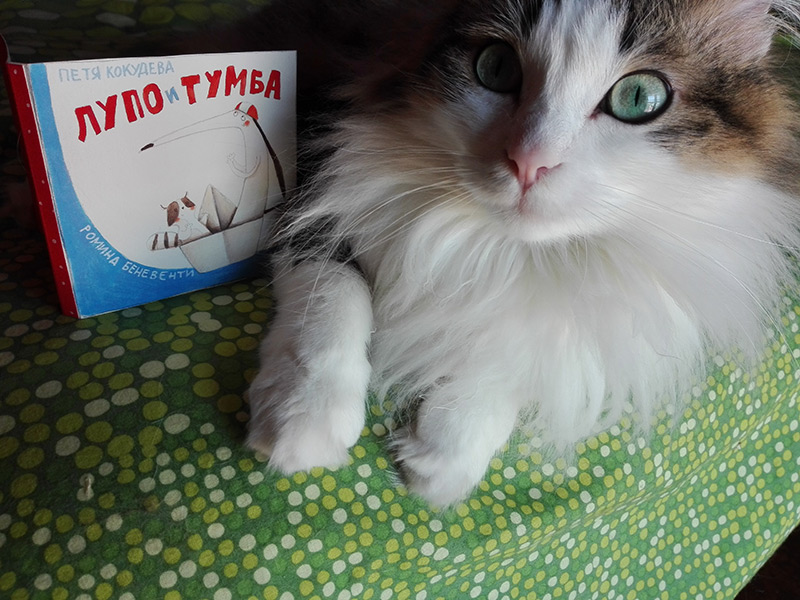
Romina Beneventi's cat Mini and a small prototype of the book which Romina did before launching the real book 8 years ago. (Photo: Romina Beneventi)
Lora, have you become attached to any particular illustration, so much so that you want to display it on your wall?
Lora: I think I would like to have them all. I don't have a favorite.
Petia, tell us a funny or unusual story related to this book, either from the time of writing or after publication.
Petia: It was hard while I was writing because I was laying out the scenes on separate pieces of paper on the carpet, and my two cats kept rolling around on them and messing up the order.
Of course, the letters from children and their parents are very dear to my heart, but what I love most is receiving actual packages: for example, I have a pillowcase completely covered in drawings of Lupo and Tumba by children. Also, I sometimes send the two puppets, Lupo and Tumba, on long-term assignments to Germany, because the children from one of the schools there put on their own plays based on the book.
Once, a beekeeping association, fans of the book, asked me for one of the episodes related to bees so they could use it on the header of their website.
What about the puppets Lupo and Tumba? Do they have a story of their own?
Petia: In the heart of Plovdiv, our city of culture, there is a wonderful place called Rakodelnitsa, filled with handmade toys. Yana, the owner, created these puppets for me because she likes the book and she likes Romina, the illustrator. She also displays a carefully curated selection of books in the shop and knows how much I enjoy bringing toys and all kinds of objects when I visit children.
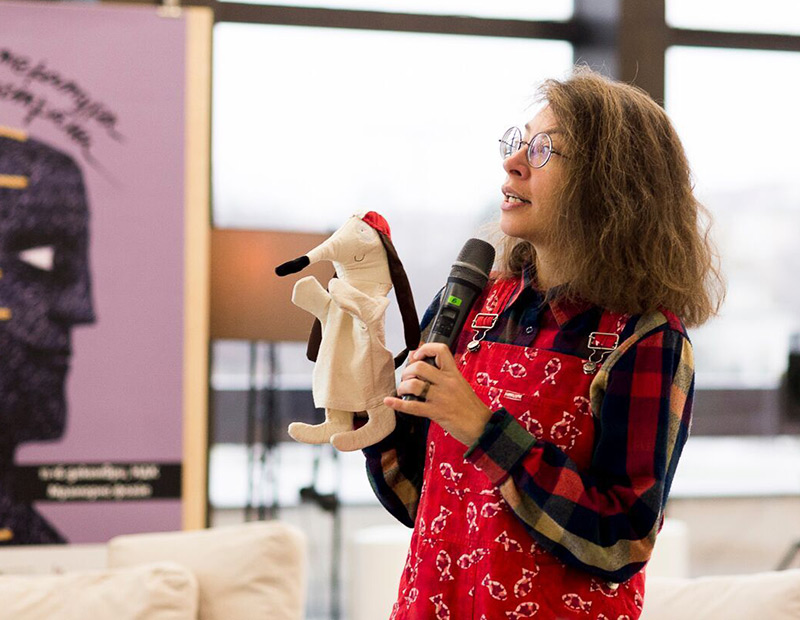
Petia Kokudeva with puppet Lupo in a meeting with kids. (Photo: Yana Lozeva)
I do not usually give traditional literary readings. Instead, I prefer to recreate parts of my books through everyday objects. This tangible, analogue world creates space for humour, playfulness, and genuine human connection. For instance, at my event in Bucharest, at the Bookfest Book Fair, I’ll bring a special card that I plan to give to Romanian kids. The idea is to present my country, Bulgaria, via details that sound like taken from a kids’ book, but are absolutely real.
Petia, Lora, what is the children’s literature scene like in Bulgaria?
Petia: I’ve been working in children’s literature for 15 years, but over the past 5 to 7 years there’s been a tremendous, even explosive boom. We literally have dozens of publishing houses specializing exclusively in children’s literature. A lot is being translated, but there’s also a huge number of Bulgarian children’s authors and illustrators who are well-known and beloved like the whimsical poet Mariya Doneva or the immensely talented and versatile visual artist Ina Hristova. My colleagues and I often visit schools and kindergartens all over the country. There are many festivals and new formats; just a few days ago, there was an exhibition of children’s books from past to present, and it was fascinating to trace the evolution in this field.
Lora: The children's literature scene in Bulgaria is very dynamic and has been going through a kind of renaissance in recent years. There are several generations of authors and we have some very talented illustrators. It is good knews that children's literature is plentiful and also offers books focused on play, inventiveness, visual experiments and philosophy made comprehensible for young readers. The audience receives these titles with huge enthusiasm, and the close collaboration between writers and illustrators has transformed the picture books into a cultural phenomenon much loved by both children and parents.
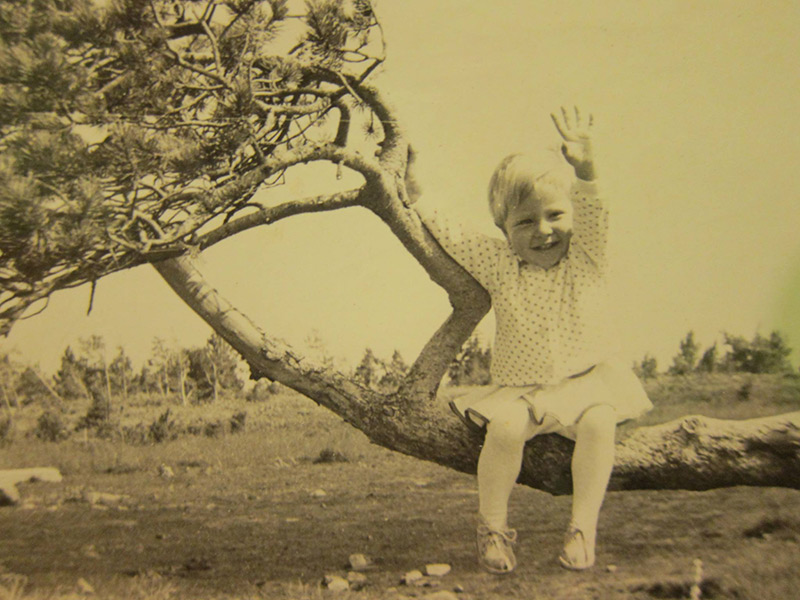
Petia Kokudeva in the mountains pictured by her father. He liked to put Petia on branches and various high places. (Photo: personal archive)
Are there any books (classic or contemporary) from Bulgarian children’s literature that you would like to see translated into Romanian?
Lora: Among contemporary authors, I would recommend Maia Dalgaceva, Maria Doneva, Julia Spiridonova, Zornita Hristova and the books of her publishing house, Tochitsa, as well as, of course, all Petia Kokudeva’s books. Among classics, although I know it would be a huge job for translators, I would recommend Angel Karaliychev and Nikolay Rainov.
Petia: My favorite Bulgarian children's author is Boris Aprilov (1921–1995), best known for “The Adventures of Lisco”. His writing combines humour and wisdom in a way that’s very hard to match.